
Six months ago we released The Infinite Crate, a DAW plugin that brings the Lyria RealTime music model into Digital Audio Workstations (DAWs) to improve the sampling workflow for producers. Since its release it’s been used by some of our favorite artists — including a wonderful showcase with Daito Manabe in Tokyo — and was featured as an exciting new music tool at NAMM 2026.
Today we’re fully open sourcing the DAW plugin for developers to fork, modify, and make their own under the permissive Apache 2.0 license.
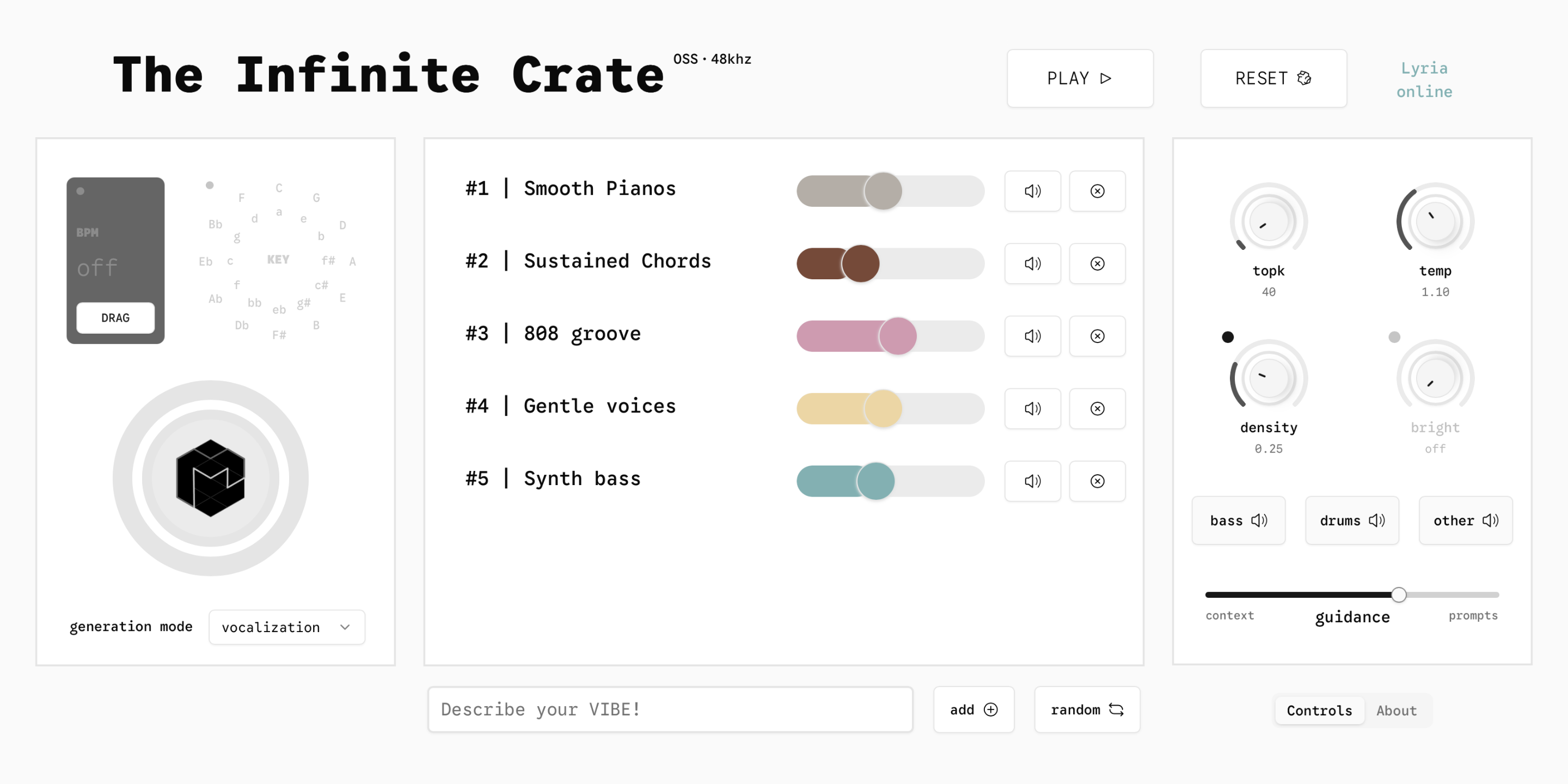
The VST was born out of discussions and studio collaborations with musicians and producers from around the world. Many were intrigued by music models as a creative partner but needed deeper integration into the tools they know and trust — Ableton, Logic, and other DAWs that support VST3/AU plugins. Bridging this gap simplifies audio routing and MIDI-mapping for studio recording and live performance, allowing musicians to focus on what matters: the music.
We architected the plugin using React/TypeScript for the UI layer and JUCE/C++ for DAW connection, audio processing, and websocket audio streaming from the Gemini/Lyria API. This allowed us to rapidly iterate on the frontend using hot-reload (Shadcn/Tailwind), while ensuring latency sensitive operations (audio streaming and playback) happen in a compiled and unmanaged language with a tight clock. State is synced between TypeScript and C++ using Zustand’s state management and nlohmann json.
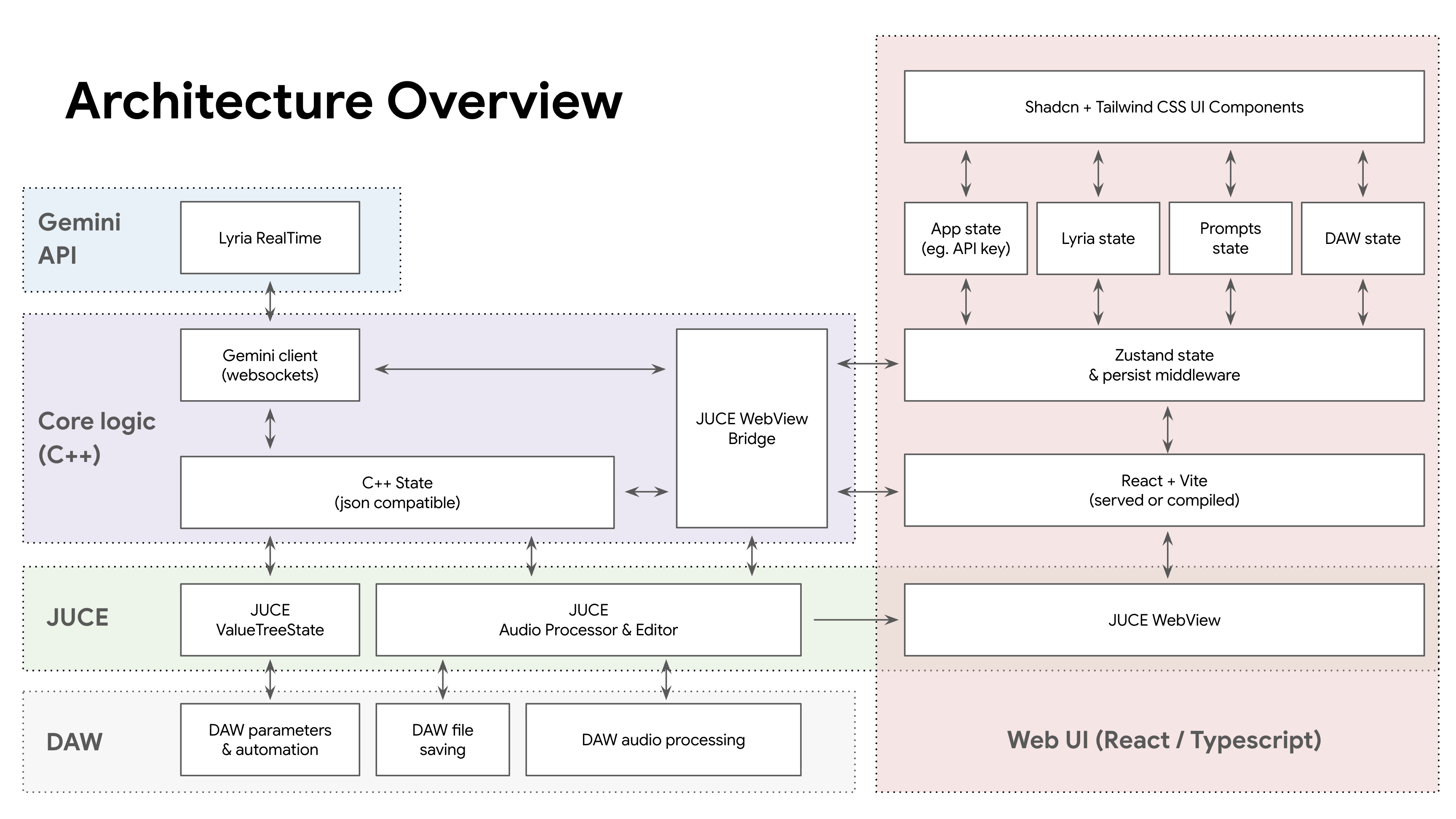
The plugin is a functional interface that exposes most of the controls available on the Lyria RealTime API to the React frontend and feeds the resulting audio stream into the DAW. Developers can fork the plugin and build creative interfaces and visualizations for the API (like Space DJ, MIDI DJ, or creative controls) directly in the DAW by spinning up the Vite server. Because the frontend uses a standard set of web frameworks it’s easy to explore new interfaces using AI-assisted coding tools like Gemini and Antigravity.
Looking ahead
In the near term, we hope to update the plugin to support on-device inference of the Magenta RealTime open-weights model for offline use. In the long term, we hope to support future music models with improved controls, such as audio and MIDI input.
We hope this open source plugin can support and be built with the growing community of music makers using machine learning as part of their creative process.
Join the discussion on our Discord.
Acknowledgments
We thank: Spencer Salazar for his talk on prototyping DAW plugins in web technologies at ADC 2020, JUCE for implementing a C++ to Web/JS bridge in JUCE 8, Tommy Cappel for rigorous testing, Alberto Lalama and Joyce Xie for their work on the API, Nikhil Bhanu for his work on the windows build, and the DeepMind research team that contributed to Lyria RealTime.